
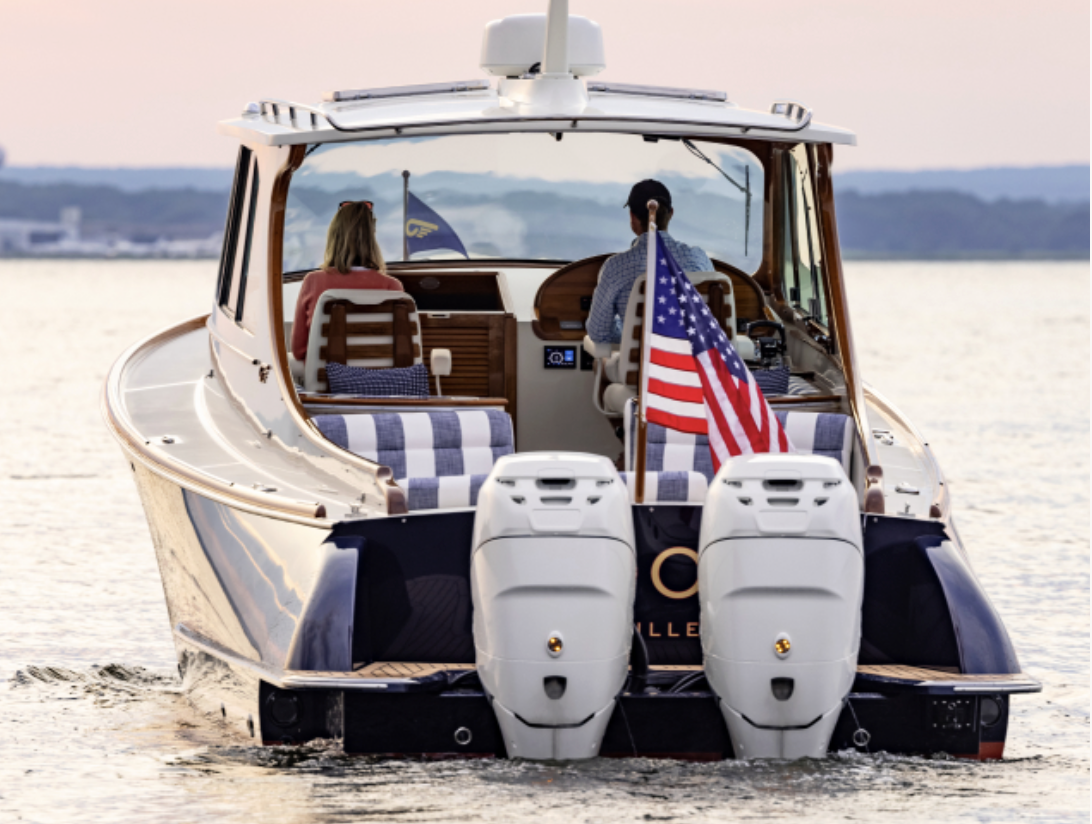
A few years ago, when Hinckley Yachts, builder of the classic Picnic Boat line of Downeast-style day boats and cruisers, decided to put twin outboards on their new 35-footer, it was clear that outboards had “arrived.”
That’s not to say that outboards were not always the power source of choice for most mid-range center consoles, fishing boats and weekenders. But, on a classic style cruiser normally powered by a diesel engine and jet drives?
In the last 15 years, we have seen a blossoming of cruisers with outboards. MJM, Back Cove, Hinckley and many others have made the move, and for good reason. From an owner’s vantage point, outboards are quieter than inboards, they are out of the living space and this opens up room in the hull for storage and they do not smell of diesel fuel.
From a builder’s point of view, going without boards simplifies the engineering of a boat and reduces the man-hours required to install a power plant. Plus, it removes the thru-hull fittings which are always a weak point in the propulsion system.
The downside lies in the need to carry gasoline on the boat which is much more flammable than diesel and the cause of most fires on recreational boats. Still, long experience with fuel tank design and construction has greatly reduced this risk. And, new diesel and electric outboards are starting to make inroads in the market.
So, how did we get to the point where outboards are now more the norm in mid-size cruising boats than ever? It comes down to the ongoing development of outboards that are suitable for the job and powerful enough to drive boats up to 50 feet.
It has been an interesting process and Mercury’s introduction of the Verado 600-horsepower outboards is now the pinnacle of that evolution.